eXroid offers an innovative direct current electrotherapy treatment for haemorrhoids, providing patients in the UK, Europe, USA and Asia Pacific including Australia and New Zealand with an effective, minimally invasive treatment option.
We are proud to have designed, developed and manufactured our device in the UK. We have dedicated significant time to researching haemorrhoidal disease and understanding the treatments available, enabling us to develop a treatment method focused on both clinical effectiveness and patient experience.
The eXroid® system is highly specialised and designed with the patient in mind, offering clinicians a carefully developed treatment approach that can provide an additional option for the management of haemorrhoids.

We have undertaken over 8000 treatments in the UK and are gaining valuable insight and understanding in the progression and changes in this disease. We undertake analysis of these treatments regularly, to understand the occurrence and prevalence and aim to publish findings so that both sufferers and medical professionals can access more data into this area in order to improve service and advice currently available.
Since eXroid’s launch in 2019, we have collected all data relating to the treatment of our patients with all 4 grades of haemorrhoid, with the aim of publishing this when enough data has been collected to show really powerful treatment responses across all 4 grades of disease.
An abstract summarising the information from the first 812 patients treated was accepted by the Association of Coloproctologists of Great Britain and Ireland (ACPGBI) for presentation at their annual conference in July 2021 and has now been published in the September 2021 edition of the medical journal, Colorectal Disease. It details a very compelling case for the safety and tolerability of the eXroid treatment.
In addition, a further abstract outlining the use of our copyrighted diagnostic tool, the eXroid Clockface Assessment Tool (eCAT), has also been accepted and has been published in the same journal. Furthermore, 3 more abstracts have been accepted by the European Society of Coloproctology (ESCP), and were presented as e-posters at the September (virtual) annual conference. Those abstracts to be published in due course, also in Colorectal Disease.

eXroid® electrotherapy: a low risk treatment for internal haemorrhoids for those taking anticoagulants

eXroid® direct current electrotherapy: a low risk treatment for all grades of internal haemorrhoids

This is the link to the pre-publication paper on eXroid electrotherapy, and further details on its clinical findings.
Direct Current Electrotherapy (DCE) was first used as a treatment for the management of internal haemorrhoids in the 19th century, with the first medical publication in 1867 on the use of galvanic current to treat internal haemorrhoids. The subsequent history of the use of DCE is an interesting one. Attempts at commercialising the technology have been made in the past with the Keesey machine in the 1920’s and the Ultroid device developed in the late 1980’s. When it was realised that there were no manufacturers of the technology from whom to source a DCE device, eXroid Technology Ltd was established and completed the design, development and manufacture of the eXroid Haemorrhoid Treatment System in the UK. It gained its ISO13485:2016 and CE accreditations before being launched into clinical use in March 2019 in the UK.
Previously, the National Institute for Health and Care Excellence (NICE) had recognised DCE as a safe and effective treatment for treating internal haemorrhoids from grades 1-3, with guidance being published in June 2015. In December 2019, NICE then published a MedTech Innovation Briefing (MIB201) which provided guidance that stated that the eXroid brand of DCE was safe and effective and could be used to treat patients suffering from internal haemorrhoids grade 1-3. NICE stated they wanted to see more peer-reviewed and published data before it would add grade 4 to the guidance as well. In the USA, however, the FDA (the Food and Drug Administration), has issued approval for the use of DCE to treat all 4 grades of haemorrhoid, indeed, it is the only treatment for haemorrhoids that has been so classified in the USA.
Understanding the disease and symptoms
This year we commissioned some much-needed research into haemorrhoid sufferers. This research is pivotal to discern sufferers’ understanding of the disease, different Haemorrhoid treatments available and the key barriers that deter sufferers from seeking treatment.
Here are the key findings we found around sufferers’ understanding of the disease and how the disease impacts them:
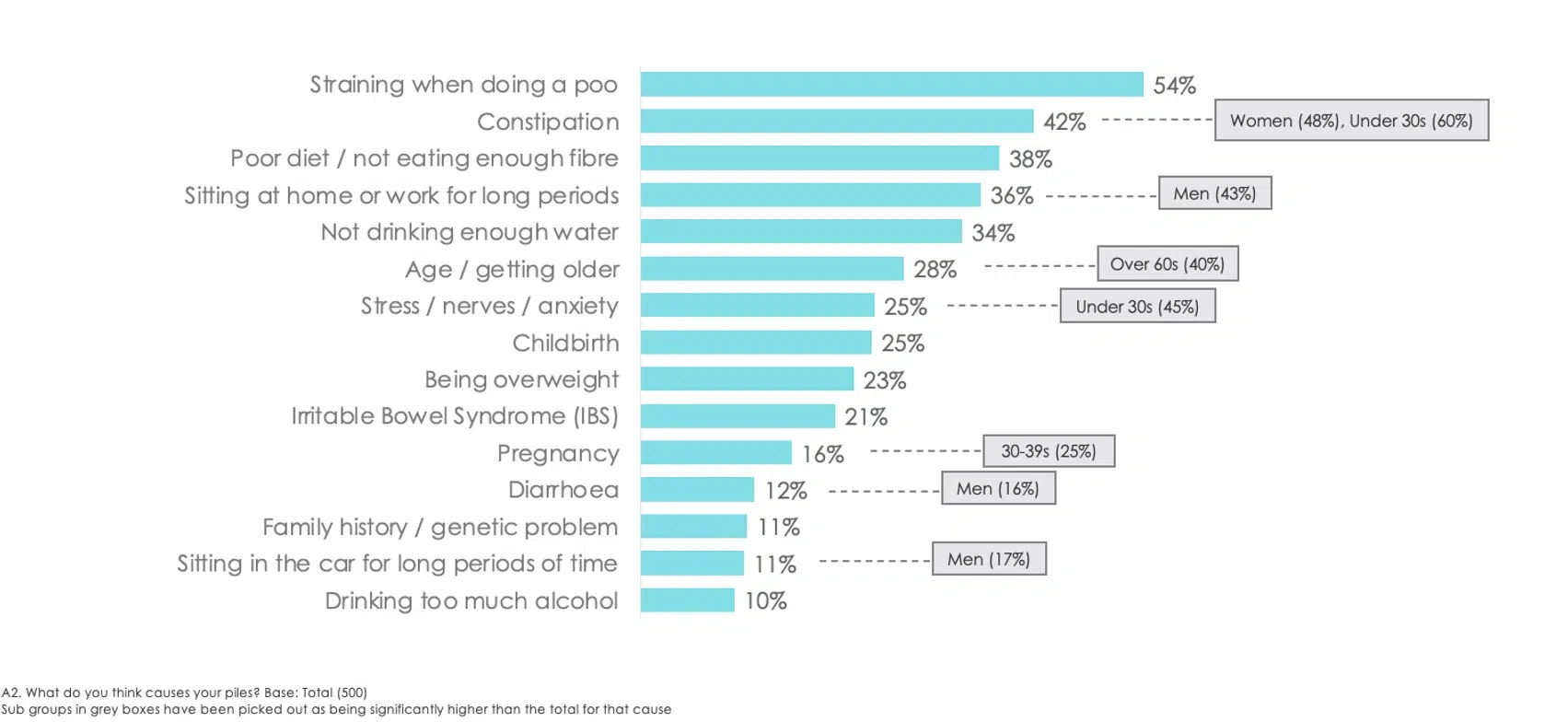
Straining, constipation, and diet were believed to be the top causes of haemorrhoids when asked what they believed causes haemorrhoids.


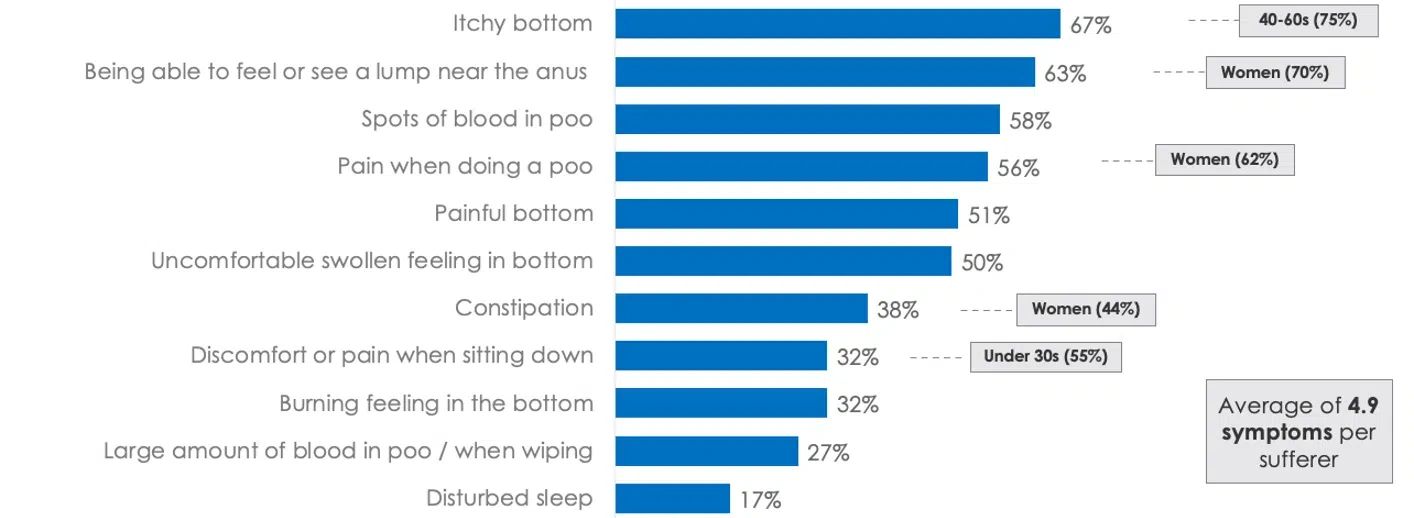
Our research confirmed that there is a wide array of symptoms that haemorrhoid sufferers can experience, making the disease hard to diagnose. On average, sufferers experience 4.9 symptoms and are likely to have experienced multiple bouts in the last year, which are known as flare-ups.
Our investigation also underlined that there is a very limited understanding of haemorrhoids, even amongst sufferers – half did not know what their type or grade of piles actually were.

So, our research found that while the causes of haemorrhoids are generally well understood, sufferers have a low awareness on the different type and grades of haemorrhoids. Symptoms do vary significantly for each sufferer, which can make the diagnosis of the disease very difficult.
For more information on the different symptoms, how to manage these symptoms and the different type of haemorrhoids, contact us.
If you have any questions then please don't hesitate to contact our team at eXroid Australia
Head Office: 18/310-312 Governor Road, Braeside VIC, 3195 Australia
Mon | 09:00 am – 05:00 pm | |
Tue | 09:00 am – 05:00 pm | |
Wed | 09:00 am – 05:00 pm | |
Thu | 09:00 am – 05:00 pm | |
Fri | 09:00 am – 05:00 pm | |
Sat | Closed | |
Sun | Closed |

Copyright © 2026 exroid.com.au - All Rights Reserved.
We use cookies to analyze website traffic and optimize your website experience. By accepting our use of cookies, your data will be aggregated with all other user data.